Austin Abrams and Zach Cregger redefine genre cinema with the record-breaking success of Resident Evil

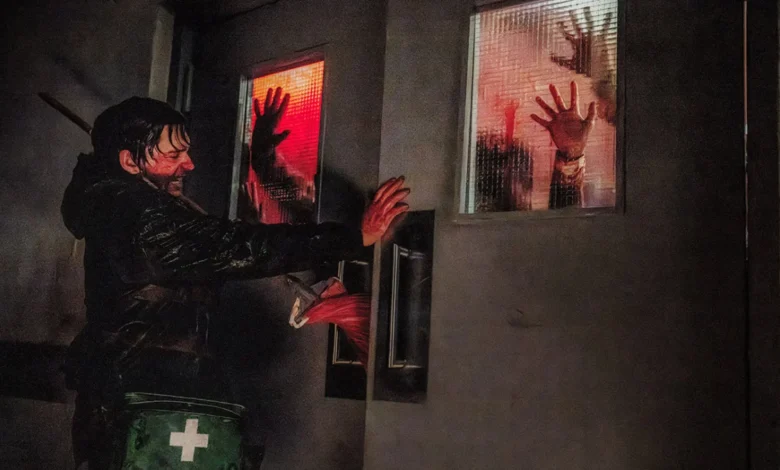
The horror landscape has been fundamentally altered this month as the latest installment in the long-running Resident Evil franchise, helmed by visionary director Zach Cregger, shattered industry expectations. The film, which stars Austin Abrams in a grueling, singular performance as a medical courier thrust into a nightmarish biological outbreak, has officially secured the franchise’s best critical reception to date and a massive $60 million domestic opening weekend. This performance marks a significant milestone for both Cregger, who has rapidly ascended to the upper echelons of modern genre filmmaking, and Abrams, who continues to establish himself as a powerhouse of physical and emotional acting in high-stakes survival narratives.
The success of Resident Evil is not an isolated incident but rather the culmination of a collaborative synergy between Cregger and Abrams that began under the duress of the 2023 industry strikes. When the initial production slate for Cregger’s previous project, Weapons, collapsed due to scheduling volatility, Abrams opted to remain committed to the project. This loyalty proved fruitful, as Weapons went on to garner both critical acclaim and an Academy Award win for supporting actress Amy Madigan. Following this triumph, the transition to the Resident Evil reboot—a property often associated with high-octane action and established lore—demanded a different, more vulnerable approach to the horror-survival archetype.

A Chronology of the Outbreak
The narrative structure of Cregger’s Resident Evil departs from the ensemble-heavy roots of its predecessors, focusing instead on a tight, claustrophobic timeline. The film centers on Bryan, a courier tasked with transporting a biological sample to Raccoon City General Hospital. The inciting incident occurs when Bryan, while distracted by a fraught phone call with his pregnant girlfriend, Michelle, strikes a pedestrian on a desolate road.
What begins as a standard road-side tragedy quickly devolves into a desperate fight for survival. The subsequent discovery that the victim is a carrier of the T-virus forces Bryan into a series of increasingly harrowing encounters. As he navigates through a rural farmstead and an abandoned tunnel system, the film meticulously tracks his physical and psychological decay. The narrative tension is sustained by the character’s struggle to maintain his humanity, even as he is forced to eliminate infected individuals, including a child in an abandoned RV, who represent the collateral damage of the Umbrella Corporation’s systemic failure.
The final act of the film delivers a bleak, nihilistic conclusion that has become a hallmark of Cregger’s directorial style. Upon reaching the lab at Raccoon City General, the intended antidote fails to manifest due to institutional incompetence, and Bryan succumbs to the infection. He ultimately transforms into the very monstrosity that has hunted him throughout the film—a creative choice that reframes the franchise’s traditional "boss monsters" as tragic victims of circumstance.

The Anatomy of a High-Stakes Performance
For Austin Abrams, the role of Bryan necessitated a departure from the traditional stoic action hero. Throughout the film, his character exhibits raw, visceral fear, often opting for reactions that mirror a civilian’s response to existential terror rather than the polished precision of a seasoned combatant.
In an interview regarding his physical preparation and on-set experience, Abrams highlighted the extreme demands of the role. Filmed shortly after his work on the survival thriller Whalefall, directed by Brian Duffield, the production schedule provided almost no respite. Abrams noted that while both films forced him into "one-man crucibles," Resident Evil required a specific blend of physical stamina and comedic timing, which Cregger utilized to punctuate the horror.
One particular sequence, involving a 150-pound prosthetic blood bag nearly colliding with the actor, serves as a testament to the production’s commitment to practical effects and high-stakes choreography. Abrams, while reflecting on the incident, expressed that the danger was largely secondary to the necessity of capturing a realistic reaction, noting that he was more focused on the shot’s integrity than his own personal safety at the time.

Thematic Implications and Cultural Commentary
The film’s conclusion, in which Bryan fails to save the day and loses his identity to the virus, has sparked significant discussion regarding the nature of modern horror endings. In an era where test screenings often pressure studios to soften the blow of a character’s demise, Cregger and Sony Pictures opted to retain the original, darker trajectory.
Thematically, the film serves as a critique of generational anxiety. Bryan’s initial reluctance to accept fatherhood, followed by his desperate, failed attempt to record a message of love and support for his partner, adds a layer of emotional tragedy to the carnage. The audience’s knowledge that Michelle will never hear his final, heartfelt admission—and will instead be left with the memory of his earlier, dismissive behavior—is a deliberate narrative choice intended to leave a lasting, haunting impression.
Furthermore, the film subtly addresses the cultural reception of video games. A climactic moment in which the protagonist credits his survival skills to his experience with gaming provides a meta-commentary on the evolution of the medium. Once viewed by some as a source of social decay, the film suggests that for a younger generation, these interactive simulations have provided a foundational framework for problem-solving and navigation under pressure.

Industry Impact and Future Trajectory
The commercial triumph of Resident Evil serves to validate the strategy of auteur-driven horror. By allowing Cregger to maintain his creative vision, Sony has secured a rare commodity: a blockbuster that feels both grounded in a popular franchise and uniquely personal.
Market analysts point to the film’s $60 million opening as a sign that audiences are increasingly drawn to films that subvert standard franchise tropes. The "downer" ending, which would have typically been a point of contention for studio executives, is now being cited as the primary driver of the film’s positive word-of-mouth. It confirms a growing trend in genre cinema where the audience’s appetite for emotional stakes outweighs the traditional desire for a triumphant resolution.
For Austin Abrams, the success of these consecutive releases—Whalefall and Resident Evil—positions him as one of the most sought-after leading men in the industry. Despite the professional success, the actor remains focused on the craft rather than the celebrity. When asked about his future plans, he expressed a desire to find roles that offer a reprieve from the relentless physical intensity of his recent work, though he remains open to the vision of collaborators like Cregger.

The industry now turns its attention to the potential for further franchise expansion. With the bar set significantly higher by this latest iteration, the expectation for future installments is that they must balance the spectacle of the Resident Evil universe with the grounded, character-driven storytelling that defined this latest success. For now, the film remains a dominant force in theaters, a testament to the power of a "gutsy" vision executed with precision.